
From 0 to 100
A century ago, the Speed family's gift launched an engineering school for a rapidly modernizing Louisville. Today, the J.B. Speed School of Engineering celebrates its centennial with an innovative new hub for tomorrow's engineering leaders. December 9, 2025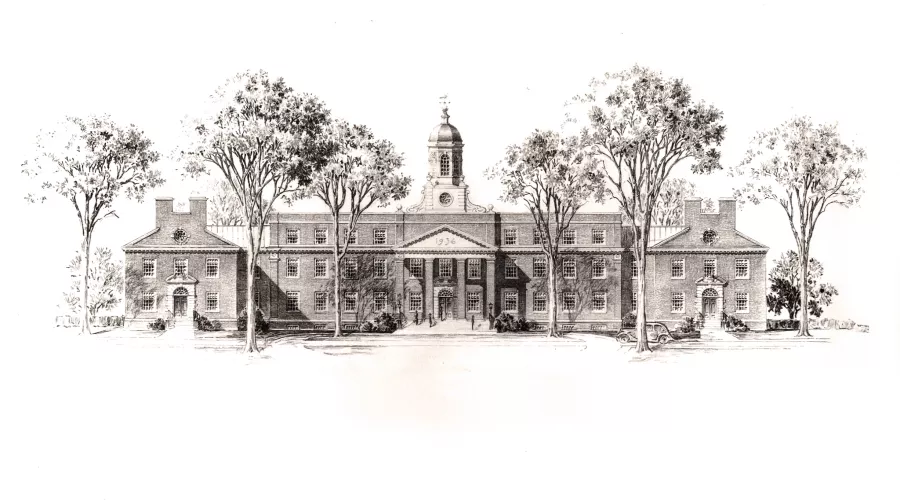
The unseasonably chilly and misty morning of Sept. 4, 2025, did not match the energy of the crowd at all.
Excitedly huddled together in the lobby of the University of Louisville’s new Engineering Student Success & Research Building (ESSRB), faculty, staff, students, alumni and political leaders stood shoulder-to-shoulder to celebrate the ribbon cutting for the $90 million state-of-the-art facility. The celebration also commemorated the legacy of 100 years of engineering education at UofL’s J.B. Speed School of Engineering.
With a backdrop of a modular classroom that better resembles a workshop, the invited speakers drummed up the building’s importance for future engineering leaders before cutting the ribbon. By the time the lunch reception was ready to begin in one of the large corner classrooms, the sun had cut through the morning’s gloom and shone through the east-facing panel windows to illuminate the space with a warm, inviting light. The four-story, 114,000-square-foot building was shimmering, a physical signal that Speed School is ready to enter its second century with a fresh momentum.
A legacy rooted in Louisville
The J.B. Speed Scientific School, as it was originally called, opened in 1925 thanks to a transformative gift from William Speed and Olive Speed Sackett. They dedicated the school to their late father James Breckinridge Speed, an industrialist whose investments in cement, coal and utilities had spurred Louisville’s growth.
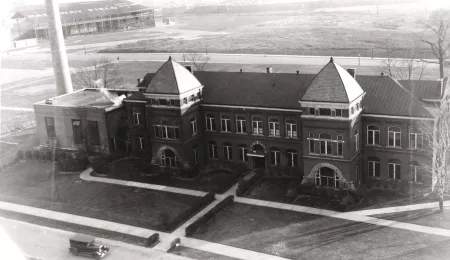
University archivist Tom Owen recalls that in the early 20th century, UofL was primarily known for medicine and law. “Louisville was bereft of a formal engineering program,” Owen said. To address the city’s growing industrial needs, UofL leaders dispatched Professor Bennett Brigman to study engineering schools nationwide. Brigman returned and advocated for a co-operative education model, which combined classroom instruction with industry placements – an idea that became the cornerstone of Speed School’s educational identity.
From its earliest days in the repurposed Leathers Building, now known as Brigman Hall, to its current home south of Eastern Parkway, Speed School has never stopped growing. As Speed School would continue to expand, Owen noted how there continued to be “a strong bonding between the School of Engineering and the community of industry and science.”
Learning from legends
Among those who led Speed School through its first century, none left a mark as deep and wide-reaching as Larry Tyler, ’63, ’67, ’76, ’85. A Louisville native, Tyler graduated from Speed with bachelor’s, master’s and doctoral degrees. He joined the Speed School faculty in 1963 and taught for 61 years – longer than any professor in UofL’s history before passing away in November 2024.
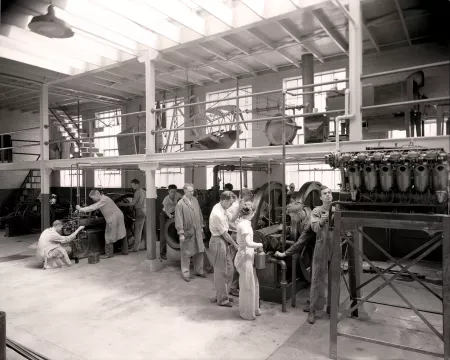
Known for his drive to teach freshmen engineering students, Tyler saw the first-year experience as the most important moment to inspire. “I stay fresh because I teach freshmen, mainly,” Tyler once said.
“He loved Speed School, and he especially loved freshmen students,” said Patricia Ralston, ’79, ’80, ’83, his longtime colleague and former student. Ralston remembers how easy it was to both work with and learn from him. “He always treated students with the same respect he did faculty. When we began co-teaching in 1999, we were genuinely a collaborating team.”
His legacy continues in the way his colleagues approach their classrooms. “I can still remember vividly the impact he had on me as a first-year student in his calculus class,” Ralston said. “It was what he said – the constant push to become analytical thinkers – that was important. I strive to inspire students similarly.”
A next-century building for next-century engineers
The ESSRB is Speed School’s most ambitious facility yet, built to prepare students for careers in robotics, cybersecurity, sustainable energy and beyond. Designed by Luckett & Farley and SmithGroup, the building is understood to be the greenest that UofL has built yet.
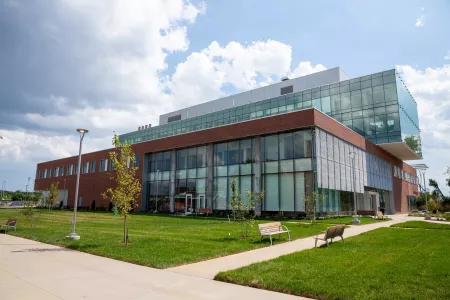
“We approached this building as a living system engineered to enhance student well-being, reduce environmental strain and evolve alongside the future of education,” said Aric M. Andrew, who led the project at Luckett & Farley. “Every design move, from geothermal systems to transparent learning spaces, reinforces the idea that sustainable buildings should actively support the people who use them.”
Inside, the building offers students much more than new classrooms and labs. “In addition to study rooms and comfortable study nooks, students will have access to a full-scale dining option, recreational space and onsite math tutoring,” said Erin Gerber, ‘08, ‘09, ‘13, associate dean of undergraduate affairs. “It will also ensure they have all of their student services groups accessible in the same building, which will ease the transition to college for many new students, particularly those who are first generation.”
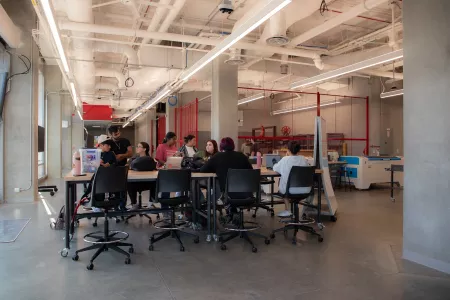
And for Speed School students, the building will transform what it means to spend time on campus.
“I have spent many afternoons and late nights with study groups taking over every corner we could find in the library and other various study lounges after stalking like hyenas to claim open tables,” said Kayla Lancaster, Speed School Student Council President. “It always raises the question, ‘What if we had one dedicated place that could bring us together on this side of campus, one space built for collaboration and creativity?’ Today, looking at this building, I can say ‘Now we do.’ ”
Carrying the centennial forward
Alumni see the new building as a unique opportunity to celebrate Speed School’s 100th birthday. On top of the new building, the centennial stands a tribute to both tradition and progress.
“I came here in 2020,” said industrial and systems engineering graduate Allison Kinnard ’24. “So, I guess I was unaware of all the previous history that this school had. But I think just to see Speed continue to excel and bring people in, and to be able to say I went here and we’re celebrating our centennial anniversary, I think it’s super cool and super exciting.”
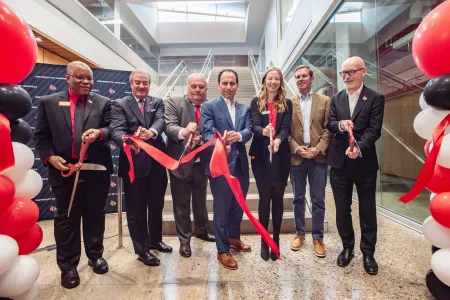
When reflecting on Speed School’s 100 years of preparing and training engineers, entrepreneur Jeremiah Chapman ’12, ’13 grasped just how exponential its impact has been. “To really think about Speed School being here for 100 years and knowing that my time was only five years of that, you start to see a hundred years of impacting hundreds of thousands of students over time. It’s incredible,” he said.
Speed School’s story is one of expansion, innovation and community – a story poised to continue for another century. As the ribbon fell on opening day and the Cardinal community streamed through the ESSRB’s glass doors for the first time, the significance of the moment was clear.
“When I think about that,” Chapman said, “I think about being in an entire network of people whose lives were changed here. That’s what I’m most proud of.”
Dive deeper into 100 years of Speed School history and visuals
See more stories from the fall/winter 2025 issue of UofL Magazine
Explore UofL Magazine
UofL Magazine is the university's premier magazine for alumni and friends. To submit story ideas, provide feedback or contact the editor, please email editor@louisville.edu.
Related News


