
Want innovation to grow? Just add light.
How interdisciplinary UofL research and development is finding a new way to solve an old problem December 9, 2025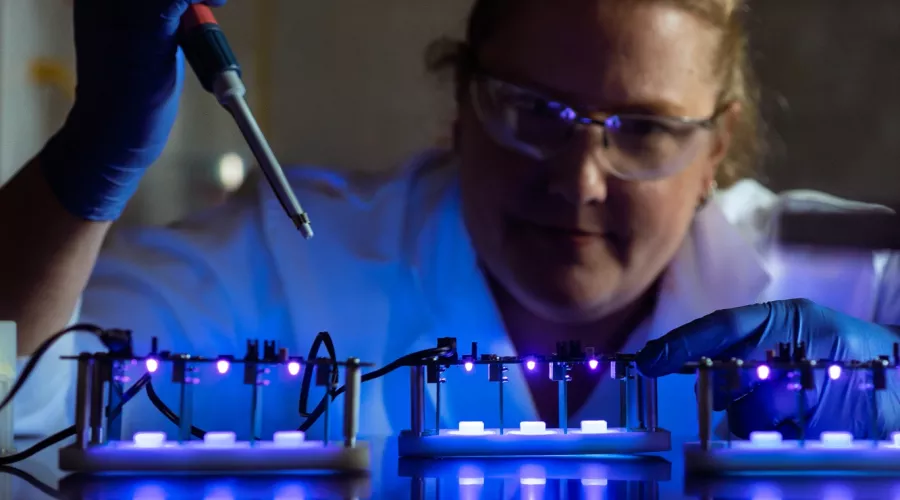
Creating and applying knowledge that improves lives is part of the University of Louisville’s mission. And solving health problems is one of the most important ways we do this.
But how does an innovative idea become reality?
Ear infections are a common problem for young children – and their parents. The standard treatment using antibiotics is often ineffective and when repeated can lead to antibiotic resistance.
As an associate professor of audiology and parent, Shae Morgan is all too familiar with ear infections. And an idea that sparked nearly a decade ago when he was a graduate student at the University of Utah may yield a possible solution.

“I learned that light can be used to kill bacteria, and I thought, ‘We get bacterial infections in the ear. What if we could shine a light in the ear canal and kill the bacteria?’ ” Morgan said.
Initial testing proved that light did kill the bacteria, at least in a dish in the laboratory.
When he joined the UofL School of Medicine, Morgan was determined to continue working on the project, now called OMeLiT, short for otitis media light therapy.
“The goal is to have a device, kind of like a hearing aid, with a tiny light on the end that goes in the ear canal and shines a very specific kind of light that is disruptive to bacteria cells until they start dying,” he said.
Morgan needed a multidisciplinary team of researchers for the project to complement his expertise in audiology and patient care. Scanning the UofL web directory, he found Debbie Yoder-Himes, associate professor of biology in the College of Arts & Sciences. He emailed her, asking for assistance testing the idea with the appropriate bacteria. Next, he reached out to Tommy Roussel, associate professor in bioengineering at the J.B. Speed School of Engineering, for device design and prototyping. The team added Douglas Jackson, John Naber, Sergio Mendes and Tricia Soucy for their expertise in electrical engineering, light delivery and biomimetic membranes.
For her part, Yoder-Himes used an initial prototype developed by the team to test various light parameters on three of the primary bacteria that cause ear infections, with exciting results.

“One ear pathogen, Moraxella catarrhalis, is virtually completely resistant to amoxicillin, the first-line antibiotic,” Yoder-Himes said. “Our light completely eliminates it within minutes. The other two big pathogens, Haemophilus influenzae and Streptococcus pneumoniae, take an hour or two to kill with our light. So, it seems like it will be super effective.”
Even with this success, a lot more testing is needed to show whether the light required to kill bacteria is safe and effective in children’s ears. Funding is needed to build a prototype. Plus, the intellectual property will need to be protected, ideally with one or more patents.
It could completely change the clinical paradigm of how we treat ear infections if we had inexpensive devices that could slide in the ear and remove the infection. – Debbie Yoder-Himes
It takes a village to take an idea from concept to commercialization, and the UofL community has abundant support to help investigators navigate the innovation landscape. The OMeLiT team has had assistance from each of their schools as well as the Office of Research and Innovation through their grant writing workshop and technology transfer experts.
These experts helped the team write and submit a grant proposal to the National Institutes of Health (NIH) for funding to develop a wearable device prototype and a model of the ear, including a synthetic eardrum, so they can find out how well the light penetrates biological materials.
Writing grant proposals, whether for the NIH or internal sources like the School of Medicine (which provided a pilot grant for the research), demands time and coordination to assemble the highly detailed information needed – researcher biosketches, lists of facilities and equipment, disclosures and more. Even after multiple revisions, the grants may or may not result in funding for the project.

The team’s NIH grant is on its second submission. Previous grant reviewers expressed concerns about whether the light would damage healthy tissue in addition to the bacteria and whether a small child would tolerate wearing a device in their ear.
“We have kids who wear hearing aids for 12 hours a day. This is completely in the realm of possibility,” Morgan said. However, the concern about damaging tissue will need further testing.
It’s a long game, but the team’s confidence in the concept sustains them through the ups and downs of the process. They may or may not succeed in this round, and if they don’t, they believe there will be other funding opportunities.
“It could completely change the clinical paradigm of how we treat ear infections if we had inexpensive devices that could slide in the ear and remove the infection,” Yoder-Himes said, highlighting that an affordable, reusable device that doesn’t require refrigeration as antibiotics do would be a great win for children’s health.
“We have an exceptional team to develop a device that delivers this novel therapy in a safe manner,” Roussel said. “A funding win would accelerate development, but we push on.”
See more stories from the fall/winter 2025 issue of UofL Magazine
Explore UofL Magazine

Betty Coffman is a communications coordinator focused on research and innovation at UofL. A UofL alumna and Louisville native, she served as a writer and editor for local and national publications and as an account services coordinator and copywriter for marketing and design firms prior to joining UofL’s Office of Communications and Marketing.
UofL Magazine is the university's premier magazine for alumni and friends. To submit story ideas, provide feedback or contact the editor, please email editor@louisville.edu.
Related News


